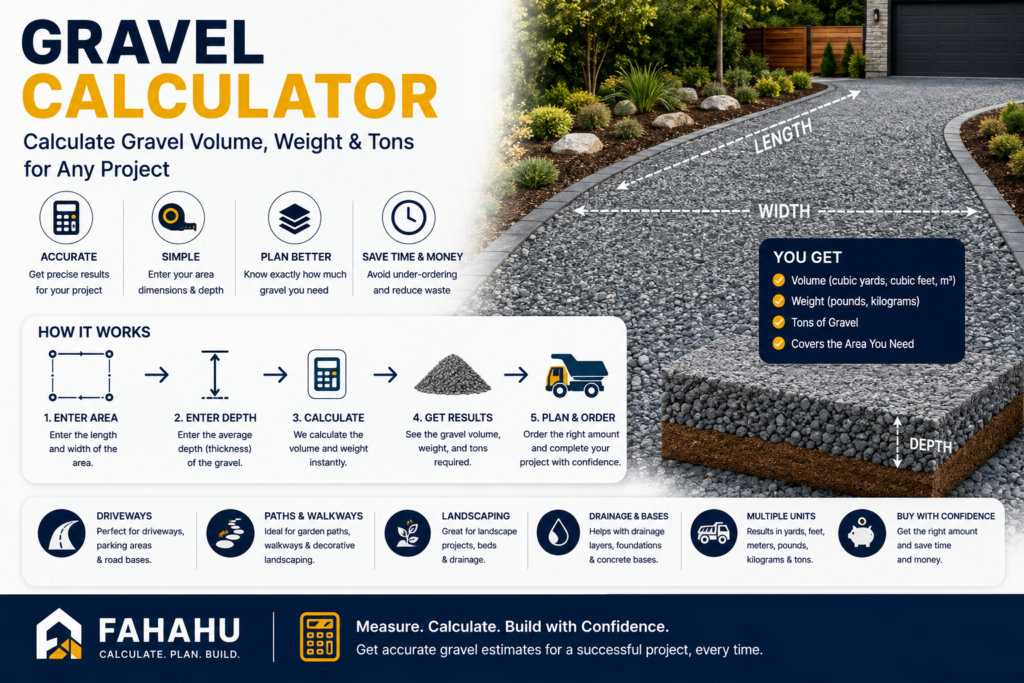
Gravel Calculator
Calculate how much gravel you need for driveways, paths, landscaping, and other projects. Enter the area dimensions and depth to estimate gravel volume and approximate material weight.
Gravel Calculator
Enter the area dimensions and gravel depth to estimate the volume and approximate material weight required for your project.
Gravel density varies by material, size, moisture, and compaction. Adjust the density if your supplier provides a specific value.
Your Estimate
Gravel Required
Includes 10% extra for waste.
Estimated Gravel Weight
Approximate weight based on the gravel density entered in the calculator.
Weight estimate uses a density of 100 lb/ft³.
How to Calculate Gravel
To estimate how much gravel you need, calculate the volume of the area you want to fill. For a rectangular area such as a driveway, path, or landscaping bed, multiply the length by the width and then by the required gravel depth.
Fahahu automatically converts your measurements into cubic yards, cubic feet, and cubic meters, includes your selected waste allowance, and estimates the material weight using the gravel density entered in the calculator.
Gravel Volume Formula
For a rectangular area, calculate gravel volume using:
Volume = Length × Width × Depth
Make sure the measurements use compatible units before multiplying. If the length and width are measured in feet but the gravel depth is measured in inches, divide the depth by 12 to convert it to feet first.
To convert cubic feet to cubic yards:
Cubic Yards = Cubic Feet ÷ 27
If you include a waste allowance, multiply the calculated volume by the additional percentage before determining the final amount of gravel required.
Gravel Calculation Example
Suppose you need gravel for an area that is 20 feet long, 10 feet wide, and 3 inches deep.
First, convert the depth from inches to feet: 3 ÷ 12 = 0.25 feet.
Calculate the volume: 20 × 10 × 0.25 = 50 cubic feet.
Convert cubic feet to cubic yards: 50 ÷ 27 = 1.85 cubic yards.
With a 10% extra allowance, the estimated amount becomes approximately 2.04 cubic yards of gravel.
If the gravel density is 100 lb per cubic foot, the estimated weight including the 10% allowance is 5,500 lb, or approximately 2.75 US tons.
How Deep Should Gravel Be?
The appropriate gravel depth depends on the project, the type of gravel being used, ground conditions, expected loads, and whether the gravel is being used as a surface layer or part of a larger base system. A deeper layer requires substantially more material, so use the depth specified for your particular project whenever available.
Common Gravel Depth Guidelines
| Project | Example Depth Range | Notes |
| Landscaping / decorative gravel | 2–3 in | Often used for beds and decorative areas |
| Garden paths / walkways | 2–4 in | Requirements vary with base preparation and use |
| Driveways | 4–8+ in | Often constructed in multiple layers |
| Drainage applications | Varies | Depends on drainage design and gravel size |
| Gravel base | Varies | Follow project or structural specifications |
Note: These are general estimating ranges, not construction specifications. Required depth can vary significantly based on soil, drainage, compaction, traffic loads, local requirements, and project design.
How Much Does Gravel Weigh?
Gravel weight depends on the material type, particle size, moisture content, and compaction. Because different gravel products can have different densities, volume alone cannot determine the exact weight.
The Fahahu Gravel Calculator uses 100 lb per cubic foot as the default Imperial density and 1,600 kg per cubic meter as the default Metric density. You can change the density field if your gravel supplier provides a more accurate value for the material you plan to use.
Gravel Weight Formula
Weight = Gravel Volume × Gravel Density
For example, 55 cubic feet of gravel at a density of 100 lb/ft³ weighs approximately 5,500 lb, which is about 2.75 US tons.
Weight estimates are particularly useful when planning material purchases or deliveries, but use your supplier’s stated density or weight-per-volume information whenever available.
Gravel Calculator FAQs
How do I calculate how much gravel I need?
Multiply the length by the width and gravel depth to calculate the volume. Make sure the measurements use compatible units. You can then convert the result into cubic yards or cubic meters and add an extra allowance if needed.
How many cubic feet are in a cubic yard of gravel?
There are 27 cubic feet in one cubic yard. To convert cubic feet to cubic yards, divide the cubic-foot volume by 27.
How much does a cubic yard of gravel weigh?
The weight varies depending on gravel type, particle size, moisture, and compaction. Using the calculator’s default density of 100 lb/ft³, one cubic yard would weigh approximately 2,700 lb, or 1.35 US tons. Use your supplier’s density or weight information when available.
How much extra gravel should I order?
An extra allowance can help account for uneven ground, settlement, spillage, and measurement differences. The calculator defaults to 10%, but the appropriate allowance depends on your project.
What gravel depth should I use?
The required depth depends on the application. Decorative areas may use a relatively shallow layer, while driveways and base applications can require considerably greater depths or multiple layers. Follow the specifications for your particular project.
Can I calculate gravel in metric units?
Yes. Select Metric to enter length and width in meters and depth in centimeters. The calculator will return the primary volume in cubic meters and estimate weight using kilograms and metric tonnes.
Why does the calculator ask for gravel density?
Density allows the calculator to estimate weight from volume. Different gravel products can have different densities, so the field is editable if you have a more accurate value from your supplier.
Need Help With Your Gravel Project?
Have your gravel estimate but need help with delivery, site preparation, spreading, or installation? Tell us about your project and location, and we may be able to help connect you with a suitable contractor or skilled professional.
Related Calculators
Planning another project? Explore more free calculators from Fahahu to estimate materials and quantities quickly.
Concrete Calculator
Estimate concrete volume and premixed bag quantities for slabs, walls, footings, and columns.
Paint Calculator
Estimate how much paint you need for walls, ceilings, and other surfaces.
Flooring Calculator
Calculate floor area, waste allowance, and the number of flooring boxes or packs required.